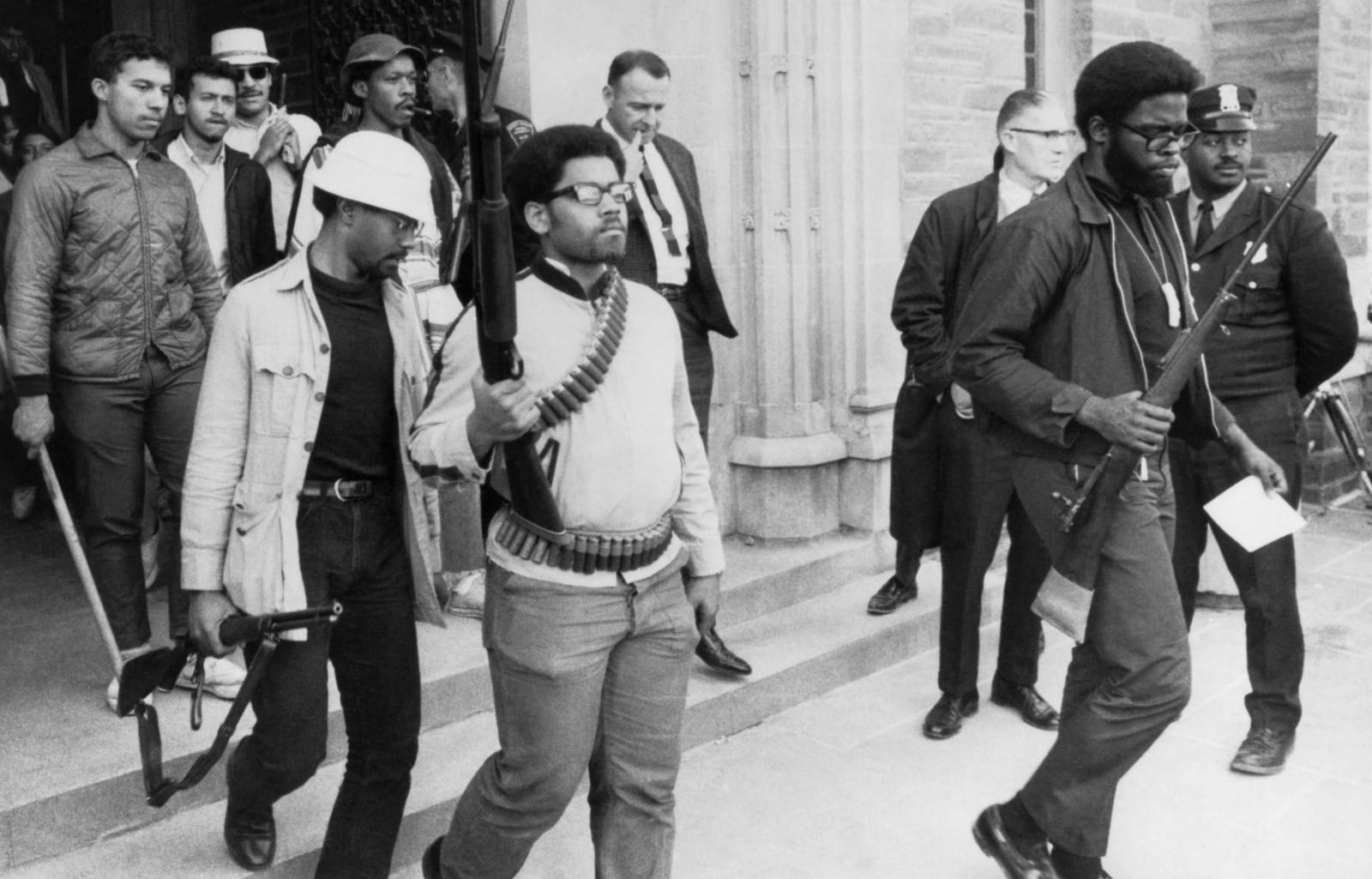
Thomas Sowell at Cornell, 1969
The week a 38-year-old economics professor watched men with PhDs surrender to teenagers carrying rifles, and never trusted a university again.
Thomas Sowell was 38 years old when he watched men with PhDs surrender to teenagers carrying rifles. He resigned within months. He has been writing about what he learned that week for the rest of his life.
It was April 1969. Cornell University. A group of students from the Afro-American Society occupied the student union, Willard Straight Hall, and held it for more than a day. When they walked out, they were carrying rifles, shotguns, and bandoliers of ammunition across their chests. A photographer named Steve Starr captured the moment. The image won a Pulitzer Prize the following year. It is one of the most famous photographs in American academic history.
To understand what that week meant, you have to know who Sowell was when he walked into it. He had been born in North Carolina, raised in Harlem by a great-aunt he believed for years was his mother, dropped out of high school, served in the Marine Corps in Korea, worked as a Western Union messenger, then put himself through Howard, Harvard, and a doctorate at the University of Chicago under Milton Friedman and George Stigler. By any reasonable measure he was already one of the more accomplished young economists in the country. He was also a man who had not yet written a single book. The Thomas Sowell on your shelf, the one whose words are on your shirt and in your head every morning, did not exist yet.
He was on the Cornell faculty that semester. Associate Professor of Economics. One of the few black professors at the entire university. He watched what happened next from the inside.
The takeover was framed as a protest over a handful of demands: an autonomous black studies program, the dismissal of certain reprimands against black students, more aggressive recruitment. It happened in the middle of a season when American campuses were already on fire. Columbia in 1968. Berkeley before that. Every administration in the country was trying to figure out how to make the noise stop without saying anything that could not be defended later. Cornell tried to thread that needle and tore through the cloth.
The faculty initially voted against capitulating to the students' demands. Then, under pressure, they met again, reversed themselves, and gave in. Men who had spent their entire careers writing about freedom of inquiry and the courage of the intellectual life folded within forty-eight hours when a group of nineteen-year-olds raised the temperature. Sowell saw it up close.
He resigned from Cornell within the year.
In his autobiography he describes Cornell as the moment that confirmed his deepest worry about the academic establishment. The people inside it would not defend it. They would not defend their stated values. They would not defend their own students. They would not even defend the truth. They had spent decades writing about courage and not one of them had any. The credentialed men in the room were the prey. The students with the rifles were the predators. Sowell was the only person in the building who refused to play either role.
He just left.
He went on to spend the next half-century writing about institutional cowardice, the vision of the anointed, the intellectuals who never face consequences, and the slow surrender of the educated class to whoever was willing to raise their voice the loudest. All of it traces back to that week in Ithaca.
Here is the part nobody tells you.
Sowell could have stayed. He was a black professor at a moment when every Ivy League school was racing to keep its black faculty. He could have made the right speech, written the right op-ed, taken the right side, and risen with the moment. He had the credentials, the timing, and the cover. Instead he walked out of a building that was no longer worth being inside of, and he chose to spend the rest of his life telling the truth about what was actually happening in there.
He is ninety-five years old now. He is still writing. His most recent book came out two years ago. The next one is in progress.
The men who folded that week are forgotten. Their books are out of print. Their names mean nothing to anyone who was not in the room. The student who pulled them into the meeting is a footnote in a photograph nobody wants to talk about anymore. And the one quiet professor who walked out without making a speech became the man whose words are quoted on millions of screens every day.
That is what one honest man with a long memory can do with a life.
Stay close,
Clay
P.S. If this piece meant something to you, you can support the writing here: ReadSowell.com/support-donate
The daily emails go out from here.
Stories like this one. Sometimes harder. The people on the list get the work first.
No spam. No algorithm. Unsubscribe anytime.